General information about this notebook
This notebook series has been initiated by the Data Management Project (INF) within the TR-172 “ArctiC Amplification: Climate Relevant Atmospheric and SurfaCe Processes, and Feedback Mechanisms” (AC)³ funded by the German Research Foundation (Deutsche Forschungsgemeinschaft, DFG)
Author(s) of this notebook:
Nina Maherndl, Leipzig University, Institute of Meteorology (LIM), Stephanstraße 3, 04103 Leipzig, nina
.maherndl@uni -leipzig .de Johannes Röttenbacher, Institute of Environmental Physics, University of Bremen, Germany, jroettenbacher@iup
.physik .uni -bremen .de
GitHub repository: https://
This notebook is licensed under the Creative Commons Attribution 4.0 International
Dataset description
Title: Cloudnet target classification during PS106
Authors: Griesche, Hannes; Seifert, Patric; Engelmann, Ronny; Radenz, Martin; Bühl, Johannes
Year: 2020
Institute: Tropos, Leipzig
Data hosted by: PANGAEA
License: Creative Commons Attribution 4.0 International
Description
The dataset contains daily netCDF-files of the Cloudnet target classification during Polarstern cruise PS106 based on the following instruments:
35.5 GHz Cloud radar MIRA,
Multiwavelength Raman polarization lidar PollyXT,
Polarstern radiosonde data
OceanRAIN optical disdrometer ODM470,
Microwave radiometer.
The data is retrieved using the instrument synergistic approach Cloudnet (Illingworth et al., 2007). This variable is a simplification of the bitfield “category_bits” in the target categorization and data quality dataset. It provides the 9 main atmospheric target classifications that can be distinguished by radar and lidar.
Target_classification: definition
0: Clear sky,
1: Cloud droplets only,
2: Drizzle or rain,
3: Drizzle/rain & cloud droplets,
4: Ice,
5: Ice & supercooled droplets,
6: Melting ice,
7: Melting ice &cloud droplets,
8: Aerosol,
9: Insects.
Contents of this notebook
The purpose of this notebook is to show how to download and use the (AC)³ data set “Cloudnet target classification during PS106”. It contains the following plotting examples:
location of the research vessel Polarstern (PS)
cloud net target classification during specified day
cloud top height during specified day
cloud base height during specified day
target classification + cloud top and base heights during specified day
Import relevant modules
# basics, data handling
import pandas as pd
import xarray as xr
from pangaeapy import PanDataSet
import datetime as dt

# plotting:
import matplotlib.pyplot as plt
from matplotlib.colors import LinearSegmentedColormap

# plotting maps
import cartopy.crs as ccrs
from cartopy.mpl.gridliner import LONGITUDE_FORMATTER, LATITUDE_FORMATTER

%matplotlib inline
Pre-processing of the imported data
The Pangaea python library pangaeapy is used to download (parts of) the data set.
ds = PanDataSet(919463, enable_cache=True, cachedir='./data')dl = ds.data # this returns a pandas DataFrame listing each available netCDF file and metadata
dl.head()Selecting the date
Pick the date from the list that you are interested in and get the index for downloading it.
dates = dl['Date/Time'].to_list()  # convert the pandas series to a list for easier search
date = dt.datetime(2017, 5, 24)  # select the date you want (should be within dates)
index = dates.index(date)
index0Take a look at all data:
Attention: If you do not select an index you need to supply an auth_token to download the complete data set. The whole data set consists of 55 datafiles (about 420 GB).
Downloading the datafile
filenames = ds.download(indices=[index])20170524_polarstern_classification.nc is being retrieved from tape. Retrying in 30 seconds...
20170524_polarstern_classification.nc is being retrieved from tape. Retrying in 60 seconds...
Downloaded 20170524_polarstern_classification.nc successfully!
Reading in the datafile
The Cloudnet data is stored in netCDF files including time and height as coordinates
data = xr.open_dataset(filenames[0])
# or if you downloaded more than one file and want to read them all in
# data = xr.open_mfdataset(filenames)
Location of the Polarstern
GPS coordinates of the Polarstern track are not included in the Cloudnet target classification dataset. If you want to see the location of Polarstern for your chosen date, you have to load the Mastertrack data (Macke (2017) and Flores (2017)). The data is also published on Pangaea, so it can be read with pangaeapy.
track_data1 = PanDataSet(881579, enable_cache=True, cachedir='./data').data
track_data2 = PanDataSet(881580, enable_cache=True, cachedir='./data').data
track_data = pd.concat([track_data1, track_data2])
track_data = track_data[(track_data['Date/Time'] > date.strftime('%Y-%m-%d 00:00:00')) &
(track_data['Date/Time'] < date.strftime('%Y-%m-%d 23:59:59'))] lat = track_data['Latitude'].values
lon = track_data['Longitude'].valuesfig = plt.figure(figsize=(6,6))
ax = fig.add_subplot(1,1,1, projection=ccrs.Orthographic(lon.mean(), lat.mean()))
ax.plot(lon, lat, 'bx', transform=ccrs.PlateCarree())
ax.set_extent([lon.min()-15, lon.max()+15, lat.min()-5, lat.max()+5], ccrs.PlateCarree())
ax.coastlines()
ax.set_aspect(0.8)
gl = ax.gridlines(crs=ccrs.PlateCarree(), draw_labels=True,
linewidth=2, color='gray', alpha=0.5, linestyle='--')
gl.top_labels = False
gl.left_labels = False
gl.xformatter = LONGITUDE_FORMATTER
gl.yformatter = LATITUDE_FORMATTER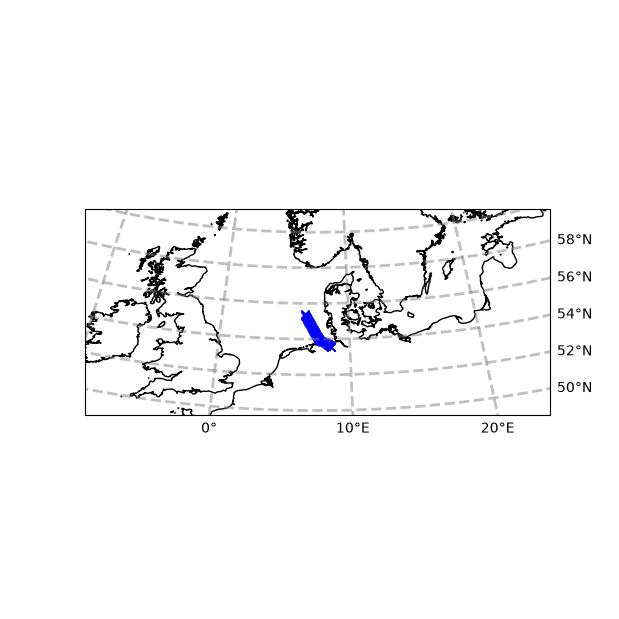
colors =  ['white', 'skyblue', 'red', 'blue', 'yellow', 'limegreen', 'orange', 'darkcyan', 'lightgrey', 'grey']
cmap = LinearSegmentedColormap.from_list('cloudnet_cmap', colors, N=len(colors))

fig, ax = plt.subplots(figsize=(8,4))
pc = ax.pcolormesh(data.time.values, data.height.values, data.target_classification.values.T,
                   shading='auto', cmap=cmap, vmin=-0.5, vmax=9.5)
ax.set_xlabel('Time (UTC)')
ax.set_ylabel('Height (m)')
fig.autofmt_xdate()

cb = fig.colorbar(pc, ticks=[0,1,2,3,4,5,6,7,8,9])
cb.ax.set_yticklabels(['Clear sky', 'Cloud droplets only', 'Drizzle or rain', 'Drizzle/rain & cloud droplets',
                       'Ice', 'Ice & supercooled droplets', 'Melting ice', 'Melting ice &cloud droplets',
                       'Aerosol', 'Insects'])
plt.show()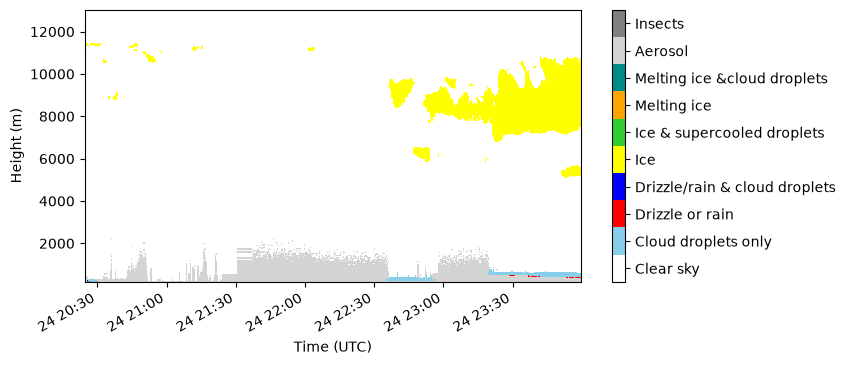
Cloud top height
fig, ax = plt.subplots(figsize=(6,4))
ax.plot(data.time.values, data.cloud_top_height.values)
ax.set_xlabel('Time (UTC)')
ax.set_ylabel('Height (m)')
ax.grid()
fig.autofmt_xdate()
plt.show()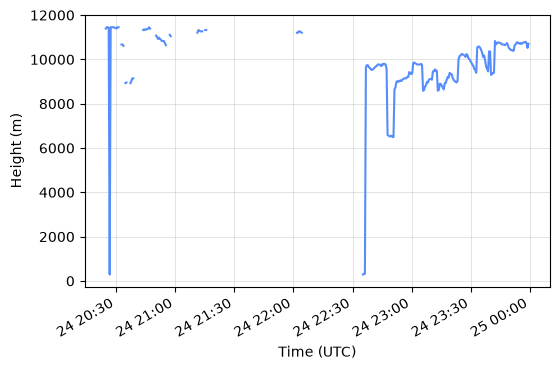
Clout base height
fig, ax = plt.subplots(figsize=(6,4))
ax.plot(data.time.values, data.cloud_base_height.values)
ax.set_xlabel('Time (UTC)')
ax.set_ylabel('Height (m)')
ax.grid()
fig.autofmt_xdate()
plt.show()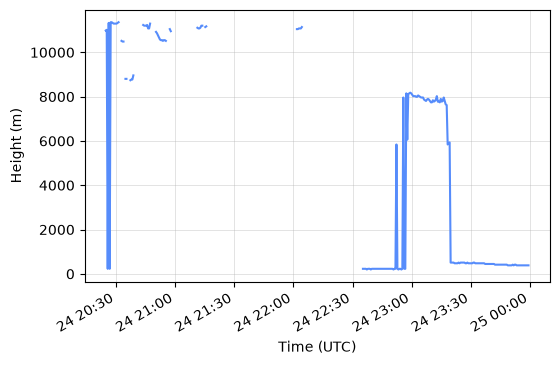
Cloud net classification + cloud base and top heights
fig, ax = plt.subplots(figsize=(10,6))
pc = ax.pcolormesh(data.time.values, data.height.values, data.target_classification.values.T,
                   shading='auto', cmap=cmap, vmin=-0.5, vmax=9.5)

ax.plot(data.time.values, data.cloud_top_height.values, 'k', lw=1, label= 'cloud top height')
ax.plot(data.time.values, data.cloud_base_height.values, color='darkviolet', lw=1, label= 'cloud base height')

ax.set_xlabel('Time (UTC)')
ax.set_ylabel('Height (m)')

fig.autofmt_xdate()

cb = fig.colorbar(pc, ticks=[0,1,2,3,4,5,6,7,8,9])
cb.ax.set_yticklabels(['Clear sky', 'Cloud droplets only', 'Drizzle or rain', 'Drizzle/rain & cloud droplets',
                       'Ice', 'Ice & supercooled droplets', 'Melting ice', 'Melting ice &cloud droplets',
                       'Aerosol', 'Insects'])
plt.legend(loc='upper right')
plt.show()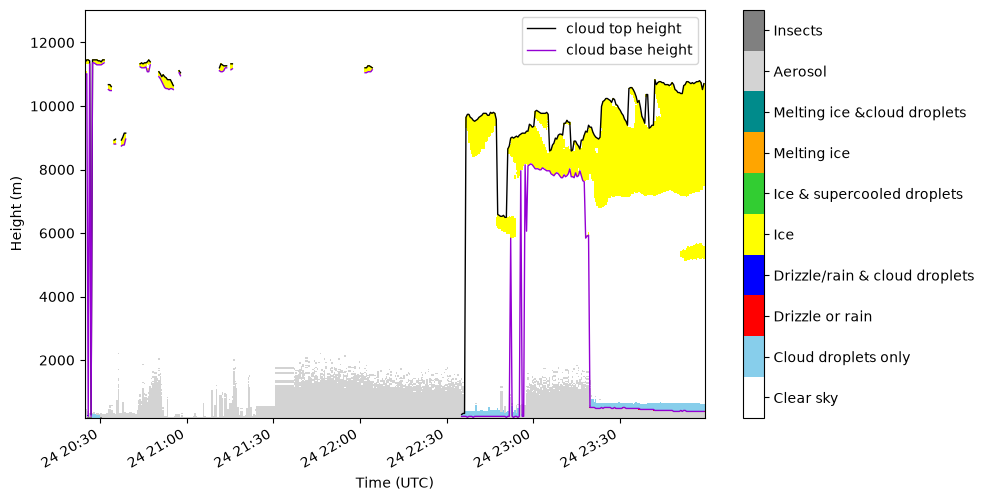
- Griesche, H., Seifert, P., Engelmann, R., Radenz, M., & Bühl, J. (2020). Cloudnet target classification during PS106. PANGAEA. 10.1594/PANGAEA.919463
- Illingworth, A. J., Hogan, R. J., O’Connor, E. J., Bouniol, D., Brooks, M. E., Delanoé, J., Donovan, D. P., Eastment, J. D., Gaussiat, N., Goddard, J. W. F., Haeffelin, M., Baltink, H. K., Krasnov, O. A., Pelon, J., Piriou, J.-M., Protat, A., Russchenberg, H. W. J., Seifert, A., Tompkins, A. M., … Wrench, C. L. (2007). Cloudnet. Bulletin of the American Meteorological Society, 88(6), 883–898. 10.1175/bams-88-6-883
- Macke, A. (2017). Station list and links to master tracks in different resolutions of POLARSTERN cruise PS106/1 (ARK-XXXI/1.1), Bremerhaven - Longyearbyen, 2017-05-24 - 2017-06-21. PANGAEA. 10.1594/PANGAEA.881579
- Flores, H. (2017). Station list and links to master tracks in different resolutions of POLARSTERN cruise PS106/2 (ARK-XXXI/1.2), Longyearbyen - Tromsø, 2017-06-23 - 2017-07-20. PANGAEA. 10.1594/PANGAEA.881580